
91ֱ²¥ Alumni Magazine
The Art of Difficult Decisions
The museum world is known for posing big questions. The Allen Memorial Art Museum has a plan for addressing them.
January 29, 2024
Annie Zaleski

‘Where Is Consent in Art (Museums)?,’ which was on display between January 27 - August 22, 2023, was the kind of perspective-altering show that’s typical for the Allen Memorial Art Museum.
Photo credit: Tanya Rosen-Jones ’97
The Northwest Ambulatory boasts an unremarkable name but a most ambitious mission. Tucked just inside the entrance of the , past a tidy display of postcards and T-shirts, the ambulatory is a tiny space custom-made for exploring big ideas. Until the late days of summer, visitors who happened upon it were greeted by the question Where Is Consent in Art (Museums)? in large text that popped off the plum-colored wall. On the opposite wall were two additional provocative questions:
Does beholding an image of desire or sexual violence implicate us in that image’s power dynamics?
When a figure looks directly at us—as if to acknowledge our presence—how do we look back?

They are guiding themes of an exhibition whose run has concluded but whose impact continues to be felt. It included works spanning from ancient times to the present day: a carved Roman Pentelic marble sculpture, a detailed woodcut, a dye sublimation print on aluminum. Each is striking on its own: a 2007 Yoko Ono work titled Touch Me consists of nothing more than the titular phrase die-cut into plexiglass on a stark white canvas; Mickalene Thomas’ You’re Gonna Give Me the Love I Need (2010) is a collage on handmade paper with accents of glitter and cloth appliqué.
The exhibition’s labels add intriguing context. The one for Thomas’ piece, which depicts a Black woman reclining on a colorful backdrop that mixes and matches patterns and textures, reads: “As a queer, Black woman depicting another Black woman, Thomas offers us a chance to consider how bias and privilege inform the way we look at reclining nudes. The declarative title, combined with the sitter’s direct gaze, signals that she is a willing and active participant in the internal dynamics of this scene.”
Where Is Consent? is a perspective-altering show, and it’s typical for the Northwest Ambulatory. Since September 2020, the space has offered three additional exhibitions: one addressing racism (), another on cultural property (), and a third on Indigenous American objects ().
“While every exhibition at a museum is designed to foster learning and conversation, these four were specifically designed to be more experimental in nature, looking at big topics in more questioning ways,” says Andria Derstine, John G.W. Cowles Director of the museum.


The inquisitive spirit is nothing new for the Allen, which has long strived to launch diverse exhibitions that engage with timely topics, often through the prism of contemporary art. It’s a commitment that, according to Derstine, increased notably under Charles Parkhurst, director from 1949 to 1962, a period when the series Three Young Americans, which started in 1951, led to early-career artists coming to 91ֱ²¥, securing the Allen’s reputation as a launching pad for new work and new ideas. Groundbreaking exhibitions continued in the years that followed, including 1970’s Art in the Mind from Athena Tacha ’61 and curator Bill Olander’s Art and Social Change (1983) and Women and the Media (1984).
Today, the legacy includes exhibitions covering sustainability (2021’s Green Japan: Images of Sustainable Living in Japanese Prints) and race, gender, and violence, including Wildfire Test Pit (2016) and Counternarratives (2018), which dealt with reporting on race and violence and which was shown on the façades of the Allen and Mudd Center.
But for all the generations of forward-thinking art, the Allen had never embarked on anything quite like this.
“As curators, we don't have all the answers. You have the conversations that you want to have in that space.”
Hannah Wirta Kinney
Rethinking Collections

The summer of 2020 found institutions of every kind finally reckoning with racial justice. Museums, in particular, confronted long-simmering issues related to the provenance of works in their collections—including by placing greater emphasis on researching Indigenous American art—and reexamined ways of discussing polarizing works.
The Allen also reimagined how to engage with current events through the lens of its permanent collection. But it also looked inward at its own practices to see what could be improved.
“I’ve heard from a number of students that the museum is this very problematic space where they see colonial-Euro-American values being reified,” says Sam Adams, the Ellen Johnson ’33 Assistant Curator of Modern and Contemporary Art. “That is true—and that’s what makes it an exciting field to work in because we have the potential to undermine and to expand those narratives.”
To start, Alexandra Letvin, the Allen’s then-assistant curator of European and American art, wanted to explore whether museum labels—the context-rich text included alongside works of art—could be anti-racist, a term used to describe actively identifying and standing against racism. That inquiry started with a series of questions, recalls Curator of Academic Programs Hannah Wirta Kinney: “What would those labels look like? What kind of information would you need to include in a label to make it anti-racist? How would the language change?”
Using two American paintings as test cases—Severin Roesen’s Still Life with Fruit (1855) and Thomas Satterwhite Noble’s The Present (1865)—Letvin wrote three different labels, which were then switched in and out over time. The goal was to illustrate that the text was subjective with interpretations often hinging on the writer’s perspective and background. In other words, the Allen aimed to show that there are many ways to tell a story about one painting.
The labels for Where Is Consent? reflected this thoughtful approach. Each one concluded with a thought-provoking question that encouraged visitors to ponder what they saw. As Kinney puts it: “How do we think about how we write about these myths? Do we lead with what the myth is about—like the rebirth of spring and seeds? Or do we say that these images also reinforce patriarchal cultures in early modern Italy? And do we talk about the power of the gaze in reclining nudes and think about those power dynamics?”
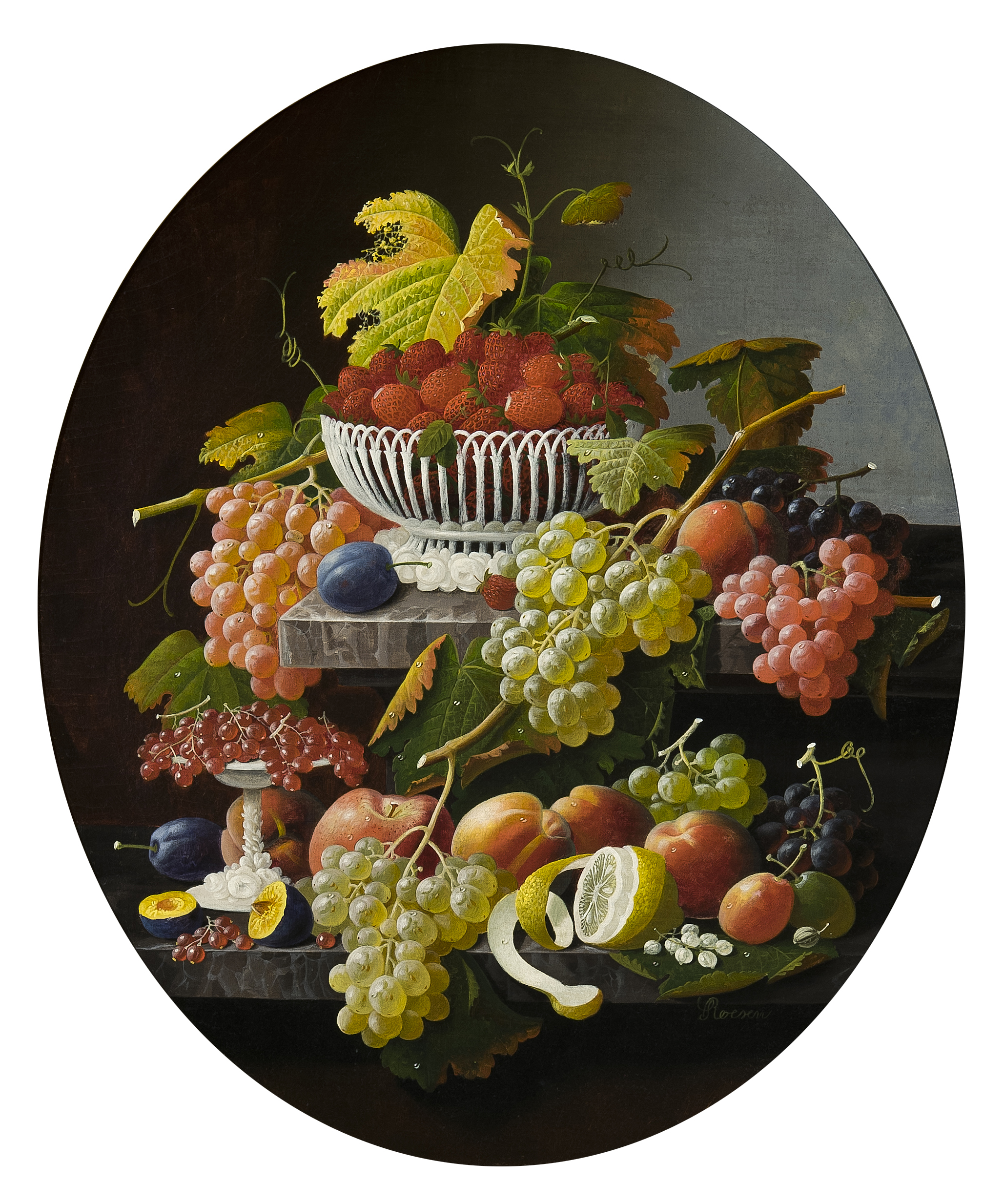
Severin Roesen, Still Life with Fruit
Given the opportunity to provide a label for this painting, how would you go about the task? Three options are listed below. How do they change your perception or understanding of the work?
Labels
An extravagant arrangement of fruit and grape vines spills out over the edge of a two- tiered marble tabletop. This stunning opulence is an impossible one: these fruits have different growing seasons and would never have appeared together on a 19th-century table. By uniting them, Severin Roesen creates an enticing but fictional image of abundance.
Following the Civil War (1861–65), American politicians promoted a variety of fruit growing projects to unite farmers across the country. These efforts drew on a rhetoric of national expansion that advocated the “civilizing” of stolen Indigenous land by clearing it for agriculture. Roesen’s still life tacitly endorses this agenda by showcasing the bounty of American soil and the wealth generated by its cultivation.
Born in Germany, Roesen moved to New York in the late 1840s. In 1862 he relocated to Williamsport, Pennsylvania, where he made this painting. Known as the “lumber capital of the world,” Williamsport boasted more millionaires per capita than any other American city. It offered a ready market of lumber barons for Roesen’s still lifes, who likely appreciated his visual celebration of the expanding country’s seemingly limitless resources.
Finding The Words
In recent years, museums and other institutions increasingly have taken up the task of crafting land acknowledgments: statements, often read before events, that recognize the Indigenous communities that previously lived on the land where a particular building now stands. Unsurprisingly, the Allen researched and drafted a land acknowledgment of its own.
For Kinney and her colleagues, the process surfaced more questions than answers— related to their approach to labels, but also how they write about American works of art and even care for items in the collection. “What does it mean to acknowledge Indigenous peoples, and how does that transform what we do?” Kinney remembers thinking.
Faced with similar conundrums, museums often set about a path of figuring out the answers on their own and launching an exhibition, then telling visitors what they should know. But as plans came together for the experimental exhibiton DIS/POSSESSION, the Allen sought to understand what the proposed images meant to people of diverse backgrounds.

To make this happen, Kinney collaborated closely with Letvin, who is now a curator of European art at the Princeton University Art Museum. “We decided we were going to use that space for a full-year project, really probing the meaning of a land acknowledgment,” Kinney says. “We decided, ‘These are all the things that we don’t know and the things that we are not sure about that we don’t have the words for yet.’ We wanted this to be a conversation about how we find the words that we should have.”
They selected a small number of works that would lend themselves to conversation, including a 19th-century landscape-style photo of the Yosemite Valley by Carleton Watkins and Andy Warhol’s 1986 pop art rendering of Sitting Bull. Of particular interest locally, however, was an 1857 painting by Frederick E. Cohen, Bentley Simons Runyan Family, depicting a well-appointed family from Mansfield, Ohio, standing in front of their equally luxurious house on a vast swath of land.
Looks can be deceiving, however. “We realized through research that although the painting presents the family as if they are standing in this land that was recently cleared for them, their house actually was in the middle of Mansfield and surrounded by other houses,” Kinney says. “For us, this became this great way to talk about settler colonialism. How could we tell the story of Ohio—a very local story, an 91ֱ²¥ story— even through this painting?”
Throughout the year that followed, DIS/POSSESSION fueled discussion from visiting classes and from collaborations with groups like Barefoot Dialogue, a student-led program presented by the Office of Religious and Spiritual Life. “For us, this was an important act of handing over authority,” Kinney says. “As curators, we don’t have all the answers. You have the conversations that you want to have in that space.”
Programming around DIS/POSSESSION culminated in a panel called “Acknowledging the Land,” which convened faculty, staff, and members of the community to discuss what it means to acknowledge the land from different perspectives. Coleading the discussion was Sundance ’92, a Muskogee Nation member who is executive director of the Cleveland American Indian Movement and business coordinator for the 91ֱ²¥ Student Cooperative Association. He was joined by photographer Joella Byron-Dixon, a recon- nected descendant of the Kanien’kehá:ka Haudenosaunee (or Mohawk Iroquois) people and cofounder of the Indigenous Peoples’ Day Committee of 91ֱ²¥.
“Every student in the room was there with intent,” remembers Byron-Dixon. “It wasn't like My professor told me I had to come for this class or I get extra credit if I’m here. I could see them diligently writing notes and asking questions.” One such question focused on whether acknowledgments are enough. It provided Byron-Dixon a chance to share her own family’s experience.
“My great-grandmother was separated from her family and from her traditions and made to feel ashamed of who she was,” she says. “She lied to people and told people that she was Greek and that her son was Greek because that was easier. So my family is very much reconnecting to our traditions, to our stories, to our dances.”
Byron-Dixon compares land acknowledgments to the reconnection process, but notes that acknowledgments are merely the first step in an ongoing process. In fact, she likens land acknowledgments to dedications.
“It’s definitely not just a one-and-done thing, where you have this beautifully written land acknowledgment [and that’s it]. It can’t be the one and only step in acknowledging traditions and acknowledging Indigenous peoples and the people who were here before us.”
Ending the Cycle of Harm
The Allen has taken this message to heart, in part by further strengthening the links between museum education, curation, and the 91ֱ²¥ community—an approach enshrined in the core tenets of the museum’s new strategic plan, which was enacted in January.

This multifaceted approach played out in Where Is Consent in Art (Museums)?, which opened that same month. For starters, the exhibition grew out of several campus initiatives, among them the student-led PRSM (Preventing and Responding to Sexual Misconduct) program, which works with the Title IX office to offer consent training and bystander intervention for first-year and transfer students. Sam Adams’ curation and scholarly work frequently explores gender, sexuality, and the body.
Prior to curating Where Is Consent?, Kinney and Adams convened a focus group of several PRSM trainers who examined around 15 works being considered for the exhibition. Their insights were invaluable to determining the final selections and the ways in which the exhibition ultimately was framed, Adams says.
“Something that will really stick with me is that they cautioned us against binaries: active/passive, male/female, perpetrator/ victim. And so we found words that compli- cate that notion.”
To Adams, being more intentional about exhibitions—and how to talk about works on display—often has more to do with overall power dynamics than gender roles.
“There are so many images of sexual assault that appear throughout art history,” they say. “We [often] put these things on view, and we talk about the mythological importance or the style, the formal elements. To me, that perpetuates rape culture. It perpetuates a harm that was originally done to this model by this artist.”
Adams cites Amedeo Modigliani’s 1917 painting Nude with Coral Necklace, which depicts an unclothed woman reclining on a chair and touching herself. Through a modern lens, the painting (part of the Allen’s perma- nent collection) can be interpreted as representing unbalanced power dynamics: a “powerful, white, cisgender male artist in his studio who has paid a really poor, most likely very hungry model to lie nude in front of him,” Adams says. “She’s probably cold. She’s probably uncomfortable. She’s being exploited, in a way.”
The Allen isn’t the only place grappling with these ideas. “Museums are facing questions of what we do with historic material—or even contemporary material— that we look at with different eyes today than we might have even 10 years ago,” Kinney says. “How do we think about the potential harm that it might cause to certain viewers—espe- cially on a college campus?”
Students are also thinking about these topics. A first-year seminar used the Allen to examine how cancel culture plays out in museums. “I thought the students would be like Put all this stuff in the basement. We can't have this stuff here. Sell it,” Kinney says. “But they were so nuanced in how they thought about how the medium of a work of art might influence how you think about consent.”
During Consent Month in April, the museum hosted weekly student-led discus- sions at the experimental space. Adams was impressed by the thoughtfulness students brought to topics around sex and consent, including when these discussions expanded to include museum visitors who may otherwise have no ties to campus.
“In those cases, it was really exciting because they're like, ‘This is a student-led program about a really adult topic that is being handled with a world-class collection of art and a really high level of sophistication,’” Adams says. “The consent exhibition—I just learned so much from students.”
The support runs both ways. When PRSM reached out across campus about planning Consent Month events, trainers Vanessa Baker ’23 and Peter Fray-Witzer ’24 found an eager collaborative partner in the Allen. They developed a curator-led viewing of the exhibition followed by small-group discussions about broader topics in art.
This balance of formal and informal was deliberate, Fray-Witzer says. “I think this is particularly poignant when you have a group of people who are around the same age living together on a college campus, who are then able to make connections between what they’re seeing in campus culture as well. This exhibition is a really good example of pulling all of these really different art pieces from different eras, sensibilities, and mediums and putting them together for this common goal and conversation.”
Fray-Witzer, a comparative literature major from Lexington, Massachusetts, credits 91ֱ²¥ for deepening his perspective on museum curation and exhibitions. He cites an art history class, taught by Associate Professor of African and Black Atlantic Art History Matthew Rarey, for which a final project required students to plan every detail of an exhibition—from wall color to placement of the artworks.
This thoughtfulness carried over to PRSM’s Consent Month events. “Peter brought in this really nice element of thinking about art as a way in which we understand the world,” Baker says. “Art, in a lot of ways, reestablishes and reinforces and reconfirms everything that we’re taught in media or by our families. And so he really emphasized that it was important to think about consent in art because it’s just another way that we learn about consent.”
Baker, who majored in politics and comparative American studies, initially visited the Allen as part of the first-year seminar James Baldwin’s America. The class viewed an exhibition on the slave trade, Afterlives of the Black Atlantic, then wrote about one of the works they saw.
The experience shifted Baker’s perspective on the possibilities inherent to museums, a revelation she attributes in no small part to Kinney making art accessible. “I always thought of art museums as places where people with knowledge understand—and people who don’t just look at art,” she says. “But to think that I have knowledge and can apply that to the things I see—it was revolutionary for me.”

Expanding Influence
In July 2022, the Allen opened an exhibition—Objects of Encounter: American Myths of Place—informed by the work that started with DIS/POSSESSION. It involved rewriting labels for objects in the American collection, Kinney says, “but also digging into our Indigenous collection in different ways.”
The speakers who took part in “Acknowledging the Land” have coalesced into a new working group that’s focused on developing a land acknowledgment for 91ֱ²¥. “What’s exciting about that project is how the museum could become a catalyst for conversations across campus between faculty and staff and different departments,” Kinney says. Fittingly, a 2023 Winter Term project called Stories of Indigenous 91ֱ²¥, led by Sundance and ethnomusicology professor Jennifer Fraser, brought together the campus and community to share Indigenous peoples’ stories of “survivance” (survival and resilience) in and through 91ֱ²¥.
All of this dovetails with Byron-Dixon’s observation that 91ֱ²¥ students have become more interested in Indigenous Peoples’ Day Committee programming and events. In the past year, the committee had its largest group of student volunteers ever.
At the Allen, meanwhile, the work also continues. Adams sat on the thesis committee of Ursula Hudak ’23, an art history major whose research took a second look at (among other things) Modigliani’s Nude with Coral Necklace. When the painting went back on display over the summer, its accompanying label reflected a much different perspective— one informed by a co-rewrite with Hudak. “It won’t concentrate on Modigliani or his brilliance or his brushwork,” Adams says. “It will concentrate on the model and her experience, which was discovered through original research that the student did. It revealed something about who this person is—and how her body was considered by this artist.”
Fray-Witzer also hopes that PRSM can carry forward its Consent Month collaboration. “No matter what the Allen has on display at the moment, the event is very applicable to a wide range of art,” he says. “The exhibition definitely provided the impetus for discussing topics related to consent, but there are so many representations of bodies and personhood in any museum that you walk into.”
With its commitment to collaboration and dialogue, the Allen is reinforcing the message that art is more than an object on a wall. It’s ever-evolving—and it takes on new dimensions as subsequent generations of students and community members engage in transformative conversations and view the same works with fresh eyes and fresh perspectives.
Illuminating the Intangible

In late August 2023, the Allen Memorial Art Museum opened a new exhibition in the Northwest Ambulatory space. features just one work: a photograph by Bey—Untitled #24 (At Lake Erie). It is part of a series exploring the Underground Railroad, its history in Northeast Ohio, and “the myth versus the reality of those places,” says Curator of Academic Programs Hannah Wirta Kinney.
Read more about the exhibition.
A Note From 91ֱ²¥
In September, Manhattan District Attorney Alvin L. Bragg Jr. obtained warrants authorizing the seizure of drawings by Austrian artist Egon Schiele (1890-1918) from the Art Institute of Chicago, the Carnegie Museum of Art, and the Allen Memorial Art Museum.
The D.A.’s Office contends that the Nazi regime stole the drawings from Fritz Grünbaum, a well-known Austrian-Jewish cabaret performer and art collector killed at the Dachau concentration camp in 1941. Prosecutors say the works rightly belong to Grünbaum’s heirs.
91ֱ²¥ College purchased Schiele’s drawing Girl with Black Hair in 1958. When questions relating to the artwork’s provenance came to light in the years that followed, 91ֱ²¥ invested significant resources researching the history of its sale and purchase and concluded it had been lawfully acquired.
The artwork was bought for the Allen by Charles Parkhurst, director of the museum from 1949 to 1962. As one of the “Monuments Men,” he was celebrated for tracking down and returning art looted by Nazis in WWII. It is inconceivable that Parkhurst would have knowingly purchased any artwork that he believed might have been stolen.
The Manhattan D.A.’s Office, through its ongoing investigation, nonetheless raised questions about the ownership of Girl with Black Hair. As a result, 91ֱ²¥ College voluntarily returned the drawing. We hope this will provide some measure of closure to the family of Fritz Grünbaum.
This story originally appeared in the of the 91ֱ²¥ Alumni Magazine.
You may also like…
Vision Accomplished
How infrastructure, collaborative partnerships, and student involvement helped 91ֱ²¥ achieve carbon neutrality

Lovely and Local
By building bouquets from sources close to home, Annika McIntosh ’01 of Hazel Designs reduces the floral industry’s environmental footprint.

Fashion Forward
Started by MI Leggett ’17 in their 91ֱ²¥ dorm room, the anti-waste, gender-free fashion line Official Rebrand is expanding aesthetics one outfit at a time.
