
Newsworthy
Prof. David Walker 鈥�72
惭补虫鈥檚 recent remark that not all 91直播 students are aspiring journalists reminds me of how many alumni have in fact chosen that profession. It鈥檚 no surprise, of course, that journalism appeals to our students, given that the qualities that make for a good journalist鈥攃uriosity, persistence, independence, a passion for the truth鈥攁re found in abundance on this campus. What I do find striking is how many former students have developed highly successful careers in the competitive world of journalism on the strength of an 91直播 degree.
Prospective students interested in journalism often wonder about the advisability of coming to 91直播, where we teach no formal journalism courses. Wouldn鈥檛 they be better off, they ask, going someplace like Northwestern or UNC, where they could take focused, pre-professional courses as a journalism major? The journalists I know say just the opposite, in fact: that a broad-based liberal arts education that trains you to think seriously and creatively, and exposes you to ideas and approaches across a range of disciplines, is much better preparation for a career that will undoubtedly take unexpected turns. A major in English, or history, or politics, or neuroscience鈥攙irtually any field, really鈥攚ill train you in skills of analysis and communication that will be useful no matter what career path you follow. The specific technical skills needed in journalism can then be acquired easily in a graduate program or internships, or through on-the-job experience.
That鈥檚 the theory, anyway, but how has it worked out in practice? Impressively well, actually, judging from the list of Obie journalists I jotted down within a few minutes. Here鈥檚 just a sampling:
[image no longer available]
Adam Moss (91直播 class of 鈥�79), editor-in-chief of New York magazine, and former editor of the Sunday New York Times Magazine. Earlier he worked for Rolling Stone, Esquire, and a wonderful weekly magazine he founded called 7 Days, but he got his start as the editor of the 91直播 Review. Here are an online interview [no longer online] with Adam and of three appearances on the Charlie Rose Show on PBS.
Michael Duffy (鈥�80) edited the Review the year after Adam, and has been at the center of Time magazine鈥檚 political coverage for over 20 years, writing or co-writing more than 40 Time cover stories, including, most recently, reports on President Bush鈥檚 proposed surge plan for Iraq, the Iraq Study Group, and an examination of what war with Iran might look like. Now , he also appears regularly on .
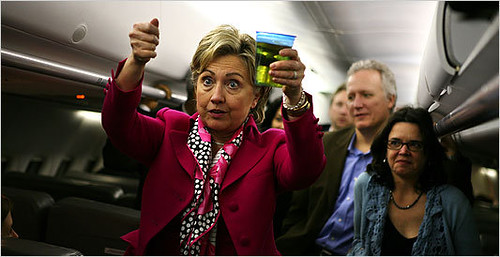
Beth Fouhy (鈥�83) was the primary reporter covering Hillary Clinton鈥檚 presidential campaign for the Associated Press. (That鈥檚 Beth just behind Clinton in the photo above.) A recent article is her analysis [no longer available] of the Unity, NH, joint press conference with Barack Obama. And Ben Stocking (鈥�81), who I believe was the Review editor the year after Michael Duffy, also works for the AP, as bureau chief in Vietnam, where he鈥檚 lived in Hanoi for the last six years. Some of his recent articles are linked here [no longer available].
After more than 20 years as a journalist, including positions as media critic for the Los Angeles Times and chief congressional correspondent for Newsweek magazine, Tom Rosenstiel (鈥�78) designed the Project for Excellence in Journalism and became its director. This important nonpartisan organization evaluates and reports on the performance of the press, about which Tom is a frequent commentator on radio and television and in print.
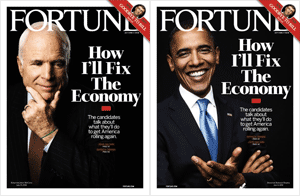
Philip Elmer-DeWitt (鈥�71) was Time's first writer about computers and produced much of the magazine's early coverage of personal computers and the Internet. After 27 years with Time, including 12 as its science editor, he joined Business 2.0 as that magazine's executive editor. He鈥檚 now a senior editor at Fortune magazine, reporting on such companies as Apple.
Jane Pratt ('84) became founding editor of Sassy, a magazine for teenage girls, at age 24, making her the youngest editor-in-chief of a national magazine ever. The notoriety of Sassy led to two books, For Real: The Uncensored Truth About America's Teenagers and Beyond Beauty: Girls Speak Out on Looks, Style, and Stereotypes. After Sassy, Jane formed Jane magazine, a lifestyle magazine for women 18-34, for which she was named Editor of the Year in 2002 by Adweek magazine. Her talk radio program can be heard on Sirius Satellite Radio.

I鈥檓 a huge fan of NPR, so it鈥檚 always a pleasure to hear former students reporting on Morning Edition or All Things Considered. Jon Hamilton (鈥�83), who also edited the Review (do you see a pattern emerging?), has been a science correspondent since 1998, covering such issues as neuroscience, health, behavior, and bioterrorism. You can hear some of his . And if you hear a story on NPR about New York theater or classical music, it鈥檚 apt to be by Jeff Lunden (鈥�80).&苍产蝉辫;

And another terrific radio program is produced and hosted by two Obies. Robert Krulwich (鈥�69) is well-known as a television correspondent for CBS, ABC, , and PBS; he has been called 鈥渢he most inventive network reporter in television鈥� by TV Guide. When he met composer and writer (鈥�95), they decided to collaborate on a science program for public radio called Radiolab, which produces some of the most fascinating radio I鈥檝e ever heard. You can . But you might want to , where they talk about 91直播 and the beginning of their collaboration. Great stuff.
So do you need to major in journalism to have a successful career as a journalist?
You tell me.
Tags:
Similar Blog Entries

Jane Wickline
Several months before I arrived on campus as a first-year, Jane Wickline was graduating. It wasn鈥檛 until the beginning of my fourth year that I became aware of who she is or even knew that she attended 91直播.

Cathy Park Hong and Real Life
There鈥檚 a lot to unpack in Hong鈥檚 narrative. What stands out to me, other than her being an 91直播 alum, is that she defines an experience that for me has been previously unspeakable.